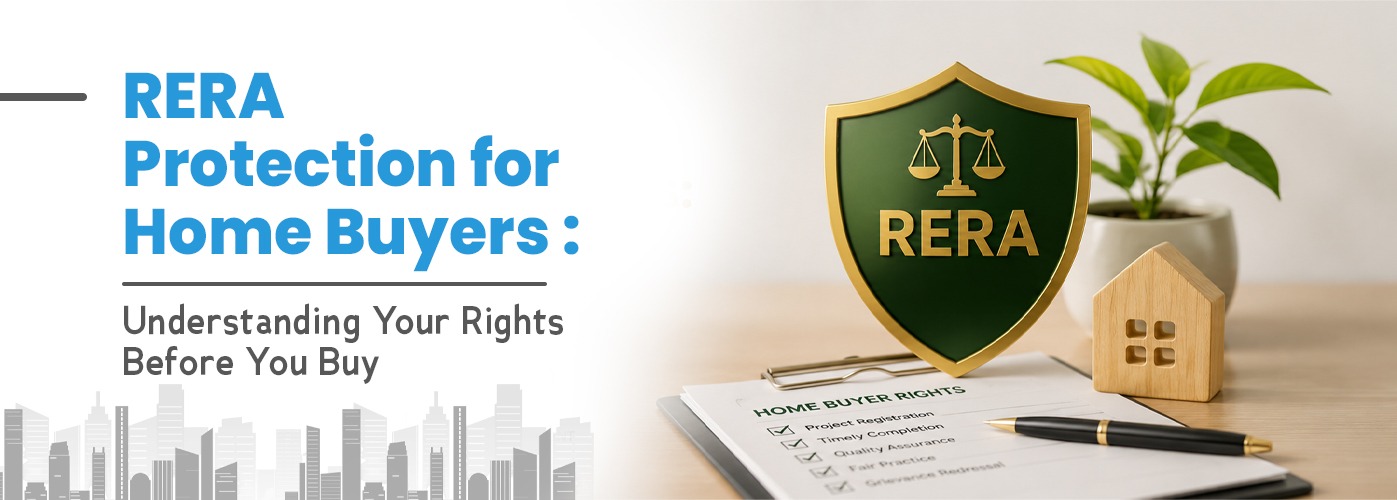
If you’re searching for RERA protection for flat buyers in Trivandrum, you’ve probably already heard two conflicting things: that RERA changed everything for the better, and that people still get burned even on “RERA registered” projects.
Both are true.
The honest answer is that RERA fixed specific, well-defined problems and left a few specific, well-defined gaps. Knowing the difference is what actually protects you, not the registration sticker on a brochure or the word “RERA” repeated across a sales pitch.
Most builders treat RERA registration as the end of the conversation, a badge that signals “trust us” and nothing more. That’s a missed opportunity because the buyers who do the best in this market aren’t the ones who trust blindly or distrust blindly. They’re the ones who know exactly which protections are guaranteed by law and which ones are still up to them to verify.
This isn’t a case against RERA. It’s a case for understanding exactly where its protection starts and where it stops, so you walk into a site visit asking the right questions instead of assuming the law has already asked them for you.
The Real Estate (Regulation and Development) Act, 2016, and Kerala’s K-RERA framework built four protections that genuinely changed the buyer-builder relationship in this state.
If a builder misses the possession date in your registered sale agreement, Section 18 gives you the right to either:
The interest rate has to match what builders charge buyers for late payments. They can no longer charge 18% on a missed installment while paying 2% on their own delays.
The brochure has to match the registered project documents.
Builders cannot alter sanctioned layouts, unit specifications, or shared amenities afterward without written consent from two-thirds of the buyers in that project.
From the date of possession, the builder must rectify structural issues, workmanship defects, or material deficiencies free of cost within 30 days of notification.
This right cannot be waived by any agreement clause.
Before a registered Builder-Buyer Agreement is signed, a developer cannot legally collect more than 10% of the property’s cost as a booking advance.
This eliminated one of the most common forms of pre-RERA financial exposure.
These four protections are real, enforceable, and worth knowing by name when you sit down with any builder.
But they don’t cover everything. The gaps are exactly where buyers get caught off guard after they’ve already chosen a RERA-registered project and assumed the rest was handled.
RERA governs the carpet area you’re paying for and the structure you’re getting. It does not specify the brand, grade, or quality of tiles, sanitaryware, kitchen units, or fittings.
If your sale agreement says “premium flooring” or “branded fittings” without naming the actual brand, model, and grade, the builder retains full discretion to interpret “premium” however they choose. There is no statutory standard within RERA to hold them to a specific quality level.
Practical Fix
Before signing, insist that the agreement’s specification schedule names the actual brand and grade for:
Avoid vague descriptions. If a builder is reluctant to commit to specifics in writing, that reluctance itself is useful information.
RERA’s role ends at a defined point: handing the project over to the Residents’ Welfare Association (RWA).
What happens after that, including:
falls outside RERA’s jurisdiction.
A builder can deliver a fully compliant project and still leave residents managing an underfunded or poorly run maintenance system for years afterward.
Practical Fix
Ask for:
Even better, speak directly with residents in the builder’s completed projects. Ask how maintenance actually works today, not how it was originally promised.
Section 18’s interest compensation is real money, and it matters.
However, it compensates for a cash flow problem. It does not solve a stalled project.
If a development is delayed by years instead of months, monthly interest payments do not replace the home you planned to move into, and they do not guarantee that the project will eventually be completed.
Practical Fix
Before booking, check the builder’s K-RERA project history.
Don’t just review the project you’re considering. Look at their completed projects as well.
Compare:
A builder with occasional short delays sends a very different signal from one whose projects routinely miss timelines by years.
Every legitimate project in Kerala carries a K-RERA registration number.
That number is meant to be checked, not just glanced at.
Visit rera.kerala.gov.in, the official Kerala Real Estate Regulatory Authority portal.
Use the public search feature and enter:
You can find these details in the builder’s brochure or agreement.
The portal will show:
This should be a routine step for any under-construction purchase in Kerala, just as you would check a vehicle’s registration certificate before buying a used car.
It takes only a few minutes, costs nothing, and often reveals information that a sales presentation won’t.
We’ve laid out RERA’s real protections and real gaps deliberately because we’d rather you make an informed decision than be reassured by a logo.
All three of our ongoing Trivandrum residences are K-RERA registered:
We encourage you to verify each registration number on the K-RERA portal before your site visit rather than taking our word for it.
On the gaps specifically, our approach is straightforward:
If you’re evaluating a flat purchase in Trivandrum, we’d rather earn your confidence through what can be verified than through what can be promised.
Verify our registration numbers on rera.kerala.gov.in, visit a completed project, and compare the experience for yourself.
That comparison is the most honest sales pitch we can offer.

Our mission is to create spaces that offer comfort, security, and long-term value for our investors and homeowners.
Quick Links





Copyright © 2026 Oceanus Dwellings. All rights reserved.
Crafted by Medowa Global