Thiruvananthapuram has two real estate markets.
There is the old city Kowdiar, Sasthamangalam, Pattom where prestigious addresses carry high land values, established schools, and the quiet comfort of decades-old neighbourhoods. And there is the northern corridor Kazhakkoottam, Aakkulam where a different kind of value has emerged, one built not on heritage but on employment density.
If you are evaluating a residential property in Trivandrum purely as a rental income asset, these two markets behave very differently. Understanding why requires looking at what actually drives rent not sentiment, not prestige, but the daily economic reality of 75,000 working professionals who need somewhere to live.
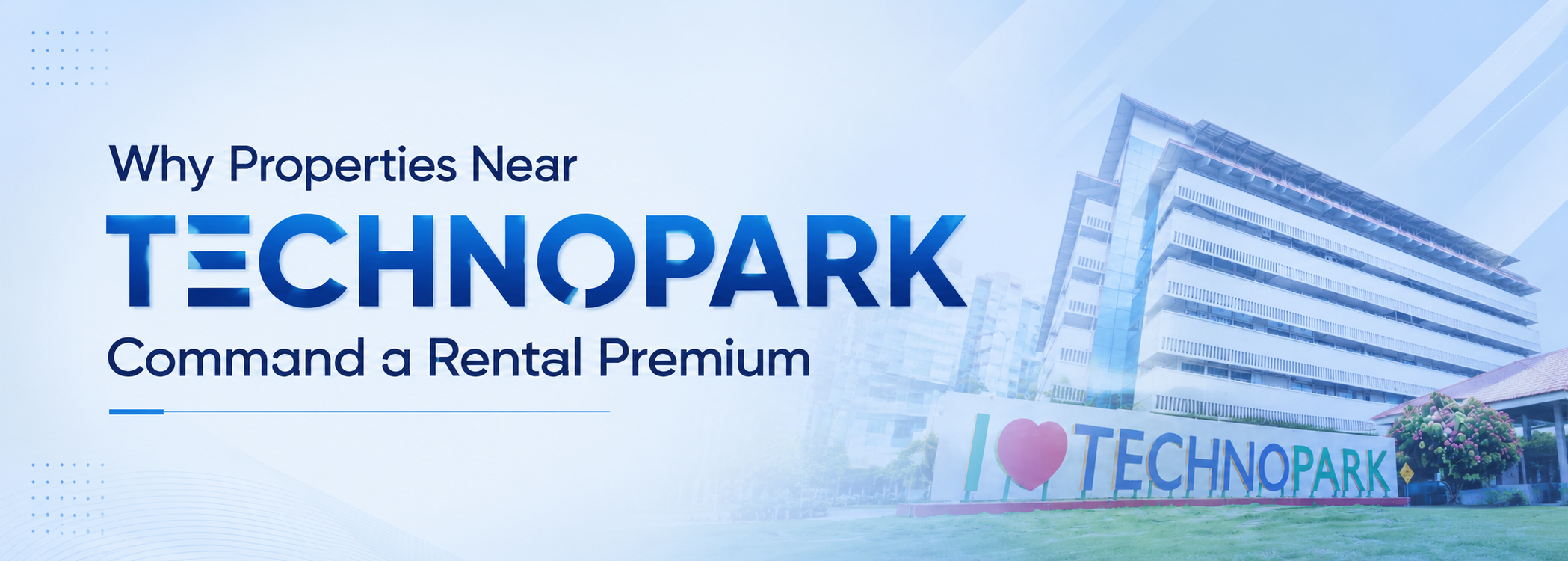
Technopark Thiruvananthapuram is not a business park in the conventional sense. Spanning 768 acres across five development phases with 11 to 12.7 million square feet of built IT infrastructure, it is one of Asia’s largest technology parks by developed area. The park hosts over 490 companies Infosys, TCS, UST Global, Accenture, HCL and its aggregate tenant workforce stands at 71,000 to 75,000 technology professionals.
That workforce is the rental market.
These are not transient workers. They are salaried IT professionals mid-career engineers, tech leads, project managers earning median salaries of ₹15–29 lakhs annually. Their housing requirements are specific: proximity to the campus, modern amenities, security, reliable water and power. Their payment reliability is high. And unlike a manufacturing zone or retail hub, the Technopark workforce does not seasonally migrate it is a permanent, growing employment base.
Phase III currently adds capacity through the upcoming ‘Downtown Trivandrum’ project by Embassy-Taurus a 5.5 million sq ft live-work-play development that will bring the next wave of professionals into the corridor. Phase IV (Technocity) focuses on AI, IoT, robotics, and space technology through the TCS Hub and the QUAD micro-township. Women comprise 45% of the current workforce a demographic that shows consistent preference for secure, managed gated communities over standalone unmanaged buildings. Every expansion adds tenants. Every new tenant needs a flat.
The Kowdiar paradox is worth noting. Despite commanding the city’s highest rents in absolute terms, Kowdiar delivers the lowest yield because its entry price is so high that even strong rental income cannot produce an efficient return. A premium 3BHK in Kowdiar bought at ₹12,162 per sq ft costs ₹2.06 crores for 1,700 sq ft. With ₹35,000 monthly rent, the gross yield is approximately 1.83%.
The same ₹35,000 monthly rent from a comparable 3BHK in Kazhakkoottam bought at ₹5,696 per sq ft produces a gross yield of approximately 4.0%. Same rent, dramatically different return on capital.
Gross rental yield is calculated simply: multiply monthly rent by 12, divide by total acquisition cost including stamp duty, registration, and furnishing. Kazhakkoottam’s lower entry cost is precisely what makes its yield profile attractive to investors who understand the difference between absolute rent and percentage return.
Within the IT corridor itself, distance from Technopark gates directly affects achievable rent.
Properties within a 1-kilometre radius command the highest premiums. The reason is practical: Technopark runs multiple shifts. Engineers working non-standard hours value a 10-minute walk over a 25-minute drive. DINK households double income, no kids prioritise convenience over space, and will pay for it.
Beyond 3 kilometres, rents soften because the commute advantage weakens. Between 1 and 3 kilometres, properties in well-managed gated communities with good amenity packages retain strong rates but standalone or older buildings in the same zone rent for significantly less. The gap between a managed gated community and an unmanaged building in Kazhakkoottam runs ₹8,000–₹12,000 per month for comparable configurations. Amenities swimming pool, gym, biometric security, EV charging, backup power are not luxuries in this tenant segment. They are baseline expectations.
The rental premium near Technopark is not just demand-driven it is also protected by supply constraints that most buyers underestimate.
Land within a 1-2 km perimeter of Technopark is largely built out. Available plots suitable for new residential development are scarce, and applicable FSI norms cap what can be constructed on remaining land. With over 88 residential projects encompassing 6,000+ units launched between 2021 and 2023, new completions are gradually entering the market but the pace of supply addition is consistently lower than the rate at which the Technopark workforce has grown. Thiruvananthapuram led Kerala in RERA residential registrations in 2024 with 2,987 units indicating strong compliant supply, but not excess supply.
This structural imbalance between supply and a growing, stable employment base supports both rental rates and occupancy. Vacancy risk near Technopark is lower than in other Trivandrum zones the tenant pipeline is continuous because the workforce is permanent and expanding. Lease churn exists professionals transfer or change roles but re-letting periods for well-maintained, amenity-rich flats in this corridor are typically short.
Three developments are expected to further intensify demand in this corridor over the next five years.
A balanced assessment of this corridor requires acknowledging two infrastructure challenges that are real and ongoing.
The Kazhakkoottam zone is experiencing a documented water supply deficit of approximately 10 MLD. The existing Kerala Water Authority pipeline from Peroorkada to Manvila is over 25 years old and prone to failure. Many apartment complexes compensate through private water tankers workable but it adds to maintenance costs and should factor into your yield model.
Separately, rapid urbanization has disrupted natural drainage in low-lying pockets within the zone. Properties near Mulluvila Colony and similar low-elevation areas have experienced flooding during heavy monsoon seasons causing physical damage and suppressing resale value. This risk is not corridor-wide. It is specific to low-elevation plots without proper stormwater drainage design.
Mitigation Strategy: Prioritise elevated developments with integrated water treatment plants, dedicated borewells, and engineered drainage. These specifications separate well-planned gated communities from opportunistic developments, and they directly protect both rental-ability and long-term resale value.
For investors targeting the Technopark rental premium, unit configuration matters. The highest-demand tenant segment mid-career IT professionals and DINK households primarily seeks 2BHK and 3BHK configurations in the 1,200–1,800 sq ft range with full amenity packages. These units minimise vacancy and maximise re-letting speed.
Oceanus Irish Gold (3BHK, 1,607–1,845 sq ft, RERA K-RERA/PRJ/TVM/110/2025) sits 1 kilometre from Technopark — directly in the highest-yield perimeter. It includes an infinity rooftop pool, biometric access, EV plug at every carpark slot, centralized gas, and solar common areas the exact amenity checklist that premium Technopark tenants expect.
Oceanus Golden Peak (2, 3 & 4 BHK, 1,266–1,629 sq ft, RERA K-RERA/PRJ/TVM/117/2024) sits in the same corridor with a configuration range that serves multiple tenant tiers simultaneously. Both are RERA-registered which matters for landlords because it confirms escrow-protected construction timelines and full legal compliance.
Book a site visit to either project to see the proximity, the amenity specification, and the rental comparable data for the immediate neighbourhood.
Multiply your expected monthly rent by 12 to get annual rental income. Divide that by your total acquisition cost purchase price plus stamp duty and registration (currently 6% of value above ₹45 lakhs in Kerala) plus furnishing. Multiply by 100 for the percentage. A ₹1.05 crore all-in investment generating ₹35,000 per month yields approximately 4.0% gross annually.
Lower than in most Trivandrum zones, but not zero. A well-maintained 2BHK or 3BHK in a managed gated community within 2 km of Technopark typically re-lets within 4–8 weeks of vacancy. Older standalone buildings or poorly maintained complexes in the same zone carry higher vacancy duration. Amenity quality and property condition are the primary determinants of re-letting speed.
For yield optimisation, 2BHK and 3BHK units in the 1,200–1,600 sq ft range consistently outperform 1BHK units (too small for mid-career professionals) and 4BHK units (limited tenant pool). The 3BHK configuration is particularly efficient in this corridor because Technopark’s DINK households and senior professionals actively seek this size, supporting both higher rent and lower vacancy.

Our mission is to create spaces that offer comfort, security, and long-term value for our investors and homeowners.
Quick Links





Copyright © 2026 Oceanus Dwellings. All rights reserved.
Crafted by Medowa Global